SERVING SOUTHINGTON AND CENTRAL CONNECTICUT

Seamless Gutter Installation in Southington, CT

Gutters are what keep water off your siding and away from your foundation. Epic Exteriors measures your home, forms seamless gutter on site, and installs a system sized to carry what your roof actually sheds in a Connecticut downpour.

GAF Certified Plus • CRCA Member • Licensed & Insured

Get a Free Gutter Estimate

Give us the basics on your house. We measure the roofline, check the fascia, and give you a written price for a complete gutter system. It costs nothing and we won’t chase you afterward.
  • Seamless gutter formed on site to fit your roofline
  • Licensed and insured, 5.0 rated by Connecticut homeowners
  • Our own crew hangs it, start to finish

"*" indicates required fields

This field is for validation purposes and should be left unchanged.
All fields marked with * are required and must be filled.
Name*
Address*

Our Gutter Services in Connecticut

A gutter system is more than a trough on the edge of the roof. It has to be sized right for your roof, pitched correctly, hung on solid fascia, and run far enough from the house to keep water off the foundation. Here’s what we install.

Why Seamless Beats Sectional Gutter

Sectional gutter comes in ten-foot lengths and gets joined together on the roofline. Every joint is a seam, and every seam is a place that eventually works loose and drips down the fascia.

Seamless gutter is rolled from a coil on site to the exact length of each run. The only joints are at corners and outlets. It holds its pitch longer, it stays cleaner along the front edge, and it doesn’t stripe your siding after a few winters.

Failing gutter is rarely just a gutter problem. Water running behind the system rots fascia, soaks siding, and collects against the foundation. Replacing the gutter is the cheap part. Fixing what it wrecks is not.

OVERFLOWING GUTTERS DO NOT FIX THEMSELVES

Get a Written Price on a New System

We measure once and give you a written price. Then you decide.

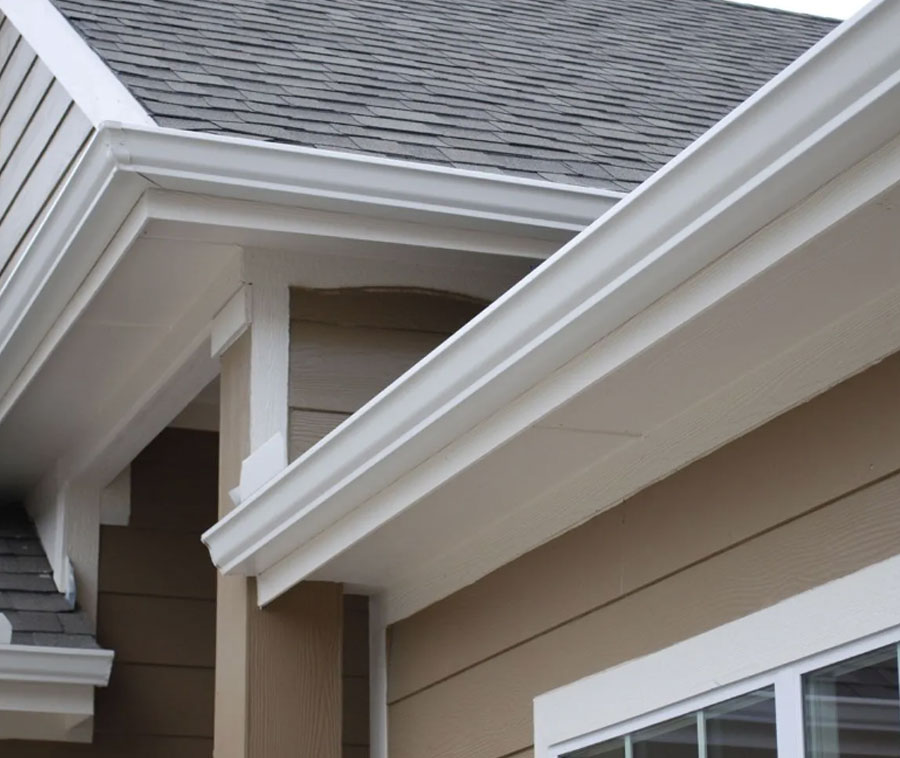
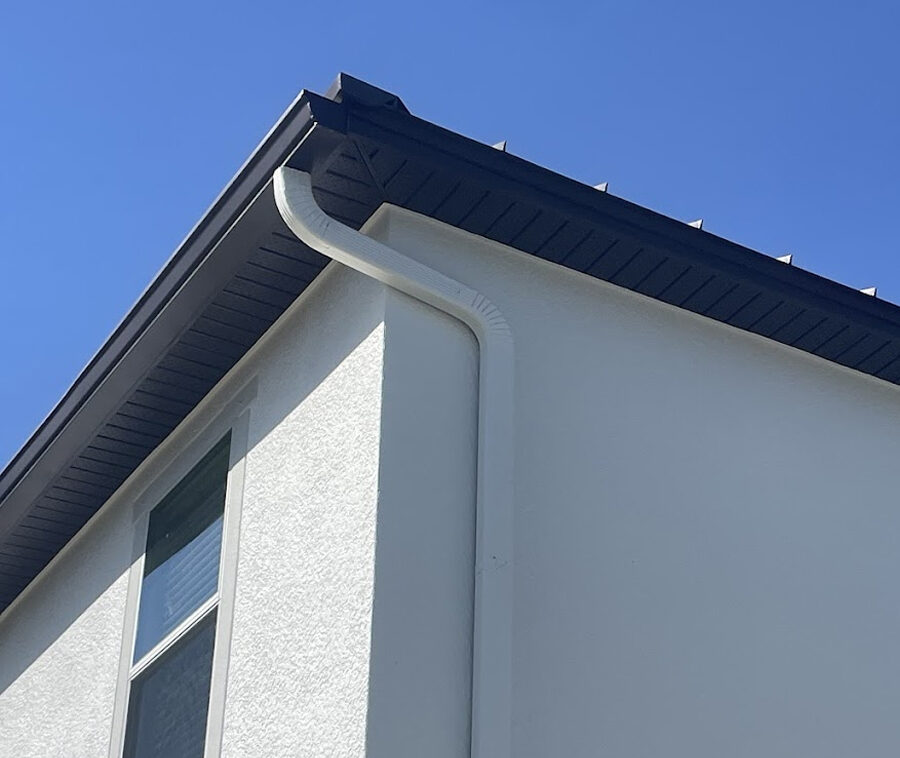
Newly installed white gutters along a roofline

Materials, Sizes and Colors

Aluminum is what most Connecticut homes get. It won’t rust, it takes a baked-on color finish, and it’s light enough to hang without stressing the fascia. Thickness matters more than most people expect: we hang .032 gauge rather than the .027 that turns up on a builder-grade install, because the thinner stock dents when a ladder leans on it and sags between hangers.

Vinyl costs less up front and suits a small run or a porch roof, but it gets brittle in cold weather and sags in long spans.

Copper is the choice on historic and high-end homes. It costs a lot, it lasts decades, and it turns that green color over the years instead of just fading.

Five inch or six inch. Five inch handles most roofs. Six inch moves noticeably more water and pairs with larger downspouts, which is the right call on a big roof, a steep pitch, or a house that has always overflowed at the valleys.

Color is matched to your trim, fascia or siding. We bring the color options with us so you’re holding them up against your actual house instead of picking off a screen.

Gutters and Roof, Done Together

The best time to hang new gutter is when the roof is already open, because the drip edge and the first course of shingles go on in the right order. If you are planning a roof replacement or dealing with storm damage, we can price the gutter system at the same visit and hang it once the new roof is on. One crew, one schedule, one clean-up. See the full roofing division.

Or call (860) 925-ROOF

The Rest of Your Exterior

Gutters are one part of the shell that keeps water out of the house. If your project touches more than the roofline, the same crew handles it.

Gutter Installation FAQ

Usually one of four things. The gutter is undersized for the roof area feeding it. There are too few downspouts, so water backs up before it can drain. The pitch has been lost, often from spikes pulling loose, and water sits instead of running to the outlet. Or a valley is dumping a large slope into one short section that was never sized for it. Cleaning does not fix any of those, which is why a system that is clear can still spill over the front edge in a heavy rain.
Most houses are a single day. We form the gutter on site, take the old system down, hang the new one, connect the downspouts and clean up before we leave. A large or complex roofline can run into a second day.
We work from the roof, not the house. What matters is the area draining into each run, how steep that slope is, and how hard it rains here. A steep roof throws water faster than a shallow one, so the same square footage needs more capacity. We measure each run separately, which is why one side of a house sometimes gets a larger gutter than the other.
Good ones do, and the fit matters more than the brand. A guard has to keep leaves out while still letting a downpour through. Whether they are worth adding comes down to what actually lands on your roof. Heavy tree cover is the obvious one, but pine needles slip straight through guards that handle leaves fine, and an aging roof sheds granules that pack in the same way. We look at what is coming down before recommending anything. A guard on a gutter that is too small or badly pitched will still overflow either way.
Roughly one for every thirty to forty feet of gutter, and more wherever a valley concentrates a lot of roof into a short run. Most of the overflowing gutters we get called out to look at are the right size but short on outlets, so the water has nowhere to go fast enough. Adding a downspout is often the cheaper half of the fix.
They help, and sometimes they solve it outright, but we would rather be straight with you than promise it. Gutters control where roof water lands. If the ground slopes back toward the house, or the discharge stops a foot from the foundation, the water still ends up in the same place. We extend downspouts well clear of the wall and will tell you at the estimate if what we are seeing looks like a grading problem rather than a gutter one.
Ice at the eaves comes down to attic heat and ventilation, not the gutter. Warm air escaping into the attic melts snow on the upper roof, the water runs down to the cold overhang and refreezes, and the dam builds from there. New gutters will not stop that, and we would rather say so than sell you something that does not fix it. What a correctly sized run does is move the meltwater as soon as it thaws. Where the ventilation is the real problem, that gets dealt with on the roofing side. More on ice dams here.
Yes. Gutters are their own job and we do them on their own. If you are also thinking about the roof, say so at the estimate and we will price both so you can see whether doing them together makes sense.
Southington, Plantsville and Milldale first, then out through central Connecticut: Cheshire, Plainville, Bristol, New Britain, Newington, Farmington, Meriden, Wallingford and the towns around them. If you’re a little further out, just ask.

Not sure what your house needs? Start with a free measurement and a written price.