Does Homeowners Insurance Cover Roof Replacement in CT?
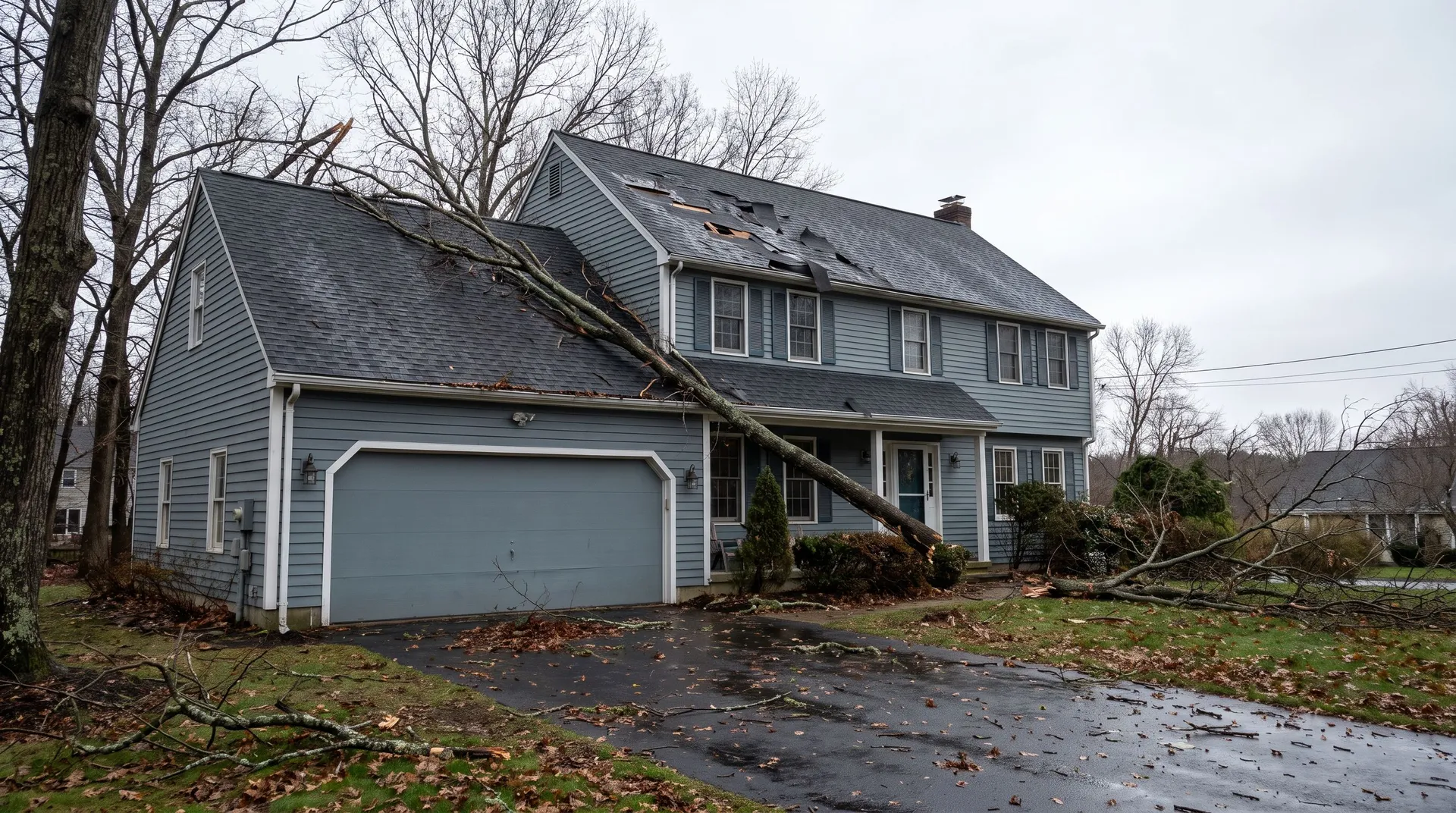
Yes. In most cases, homeowners insurance covers roof replacement in Connecticut when a sudden, covered event causes the damage: wind, hail, a fallen tree, or ice. It does not cover a roof that failed from age, wear, or neglect. The line between those two answers decides nearly every roof insurance claim.
Here is what a standard policy covers, what the storms do, how a claim moves from phone call to new roof, and when filing is not worth it.
What homeowners insurance covers on a roof
A standard homeowners policy covers sudden and accidental damage from named perils. For roofs in Connecticut that usually means wind, hail, the weight of ice and snow, falling objects such as tree limbs, fire, and lightning. If one of those events damages your roof, the policy pays to put it back the way it was, minus your deductible.
That can mean a full roof replacement or a partial one. The insurer decides based on how much of the roof is damaged, whether the existing shingles can still be matched, and what your policy says. Interior damage that follows a covered roof event, like a stained ceiling or wet insulation, is usually covered under the same claim.
The same test answers whether home insurance will cover a roof leak. The policy pays when a storm caused the leak. It does not pay when the shingles simply wore out.
What it does not cover
Insurance pays for events, not for a roof that reached the end of its life. Most policies exclude:
- Wear and tear. Curling, granule loss and brittle shingles are age, not damage.
- Neglect. A leak you knew about and left alone becomes a maintenance problem the moment the adjuster reads your claim.
- Poor installation. Bad flashing or nailing is a workmanship issue, and insurers treat it as one.
- Defective materials. That is what a manufacturer warranty is for. Insurance covers sudden damage; a GAF warranty such as System Plus or Silver Pledge covers manufacturing defects. The two do not overlap.
Age is the gray area. A 20-year-old roof can take real wind damage, and that damage is still covered. But an old roof that leaks in ordinary rain is a replacement you pay for yourself. If you are not sure which side of that line you are on, our guide on when a roof is worth keeping and when it is time to replace walks through the signs.
The storms behind most Connecticut roof claims
Central Connecticut gets its roof damage from a short list of events, and most of them arrive between November and March.
- Nor’easters. Sustained wind off the ocean, often with heavy wet snow. They lift shingles along ridges and rake edges and drive water under anything already loose.
- Straight-line wind. Summer thunderstorms and winter fronts both produce gusts that peel shingles and tear off ridge caps.
- Hail. Less common here than in the Midwest, but a hail cell will bruise shingles and strip granules across a whole slope.
- Fallen limbs and trees. Mature oaks and maples plus wet snow or ice equal punctures and crushed decking.
- Ice dams. Snow melts, refreezes at the eaves, and backs water up under the shingles. The water damage inside is usually a covered loss. Our guide to New England ice dams explains how they form and how to keep them off your roof.
Actual cash value vs replacement cost, and recoverable depreciation
This is where most homeowners get surprised. Your policy pays one of two ways.
Replacement cost value (RCV) pays what it takes to replace the roof with comparable materials today.
Actual cash value (ACV) pays replacement cost minus depreciation. Depreciation is the value the roof lost through age. On an older roof, that can be most of the claim.
Most replacement cost policies pay in two parts. The first check is the ACV amount. The difference between that and the full replacement cost is called recoverable depreciation. The insurer holds it back until the work is done, then releases it when you submit the final invoice. If you never replace the roof, you never see the second check. Some policies set a deadline for finishing the work, so read yours.
In plain terms: if your roof has lost 40 percent of its value to age, the first check covers 60 percent of the replacement cost minus your deductible. The other 40 percent arrives after the new roof is installed.
Does your roof’s age matter?
Yes, and more than it used to. Many insurers now attach a roof age schedule to the policy. Past a certain age, often 15 or 20 years, the roof is covered at actual cash value only, even if the rest of the house is on replacement cost. Some carriers will not write a new policy on a roof past a set age without an inspection.
So will home insurance cover roof replacement on an older roof? If a storm damaged it, yes, but the payout may be reduced by depreciation. Check your declarations page and any roof endorsement attached to it. If you see “ACV” or “actual cash value” next to the roof, plan for a smaller check. Roof age and insurance connect in one more way: replacing a roof before it fails can restore full replacement cost coverage and sometimes lower the premium. Ask your agent.
Wind and hurricane deductibles
Your standard deductible is a flat dollar amount. Some Connecticut policies, especially nearer the shoreline, carry a separate wind or hurricane deductible written as a percentage of your dwelling coverage. It applies when a named storm triggers it. That percentage can be several times your normal deductible, which changes whether a claim is worth filing at all. It is listed on your declarations page. Know the number before a storm, not after.
How a roof insurance claim works, step by step
If you are wondering how to get insurance to pay for roof replacement, the answer is documentation and sequence. Here is the order.
- Stop further damage. Your policy requires you to protect the property. If water is coming in, get the roof tarped. Keep the receipt; emergency mitigation is usually reimbursable.
- Photograph everything. Roof, attic, ceilings, debris in the yard, the tree if one fell. Take the photos before any tarp goes on.
- Get a contractor inspection. A roofer who walks the roof and writes a report with measurements gives you a factual record and gives the adjuster something to check against.
- Call your insurer. Open the claim, give the date of the storm, and get a claim number. Do not wait weeks; most policies require prompt notice.
- Adjuster visit. The insurer sends an adjuster to inspect. Have your contractor there. Two sets of eyes on the roof catch more than one.
- Approval and scope. You receive a scope of loss listing what the insurer will pay for, plus the first ACV check. Compare it to your contractor’s report. If they differ, your contractor can submit a supplement to the adjuster.
- Replacement. The roof is replaced according to the approved scope.
- Recoverable depreciation. Send the final invoice to the insurer and request the held-back amount.
If the insurer’s scope and your contractor’s findings stay far apart, a public adjuster licensed in Connecticut can represent you for a percentage of the settlement. That is an option, not a requirement.
What to say to an adjuster, and what not to
Adjusters are not the enemy. They are measuring a claim against a policy, and the most useful thing you can give them is clarity.
- Stick to facts: the date of the storm, what you saw, when you saw it.
- Do not guess at the cause. “I think it was the wind” is a guess. “The shingles were on the lawn the morning after the storm” is a fact.
- Do not guess at the roof’s age. If you do not know, say so and let the records show it.
- Do not say the roof has been leaking for a while unless it has. If it has, say so plainly. Hiding it is worse.
- Let the photos and the contractor report speak. That is what they are for.
One warning. Any contractor who offers to “cover” or “waive” your deductible is a red flag. The money has to come from somewhere, usually an inflated claim, and your name is on the paperwork. Walk away.
When a claim makes sense, and when it does not
File when the damage is clearly storm-related and the cost of the work is well above your deductible. Full replacement after a wind or tree event is the clearest case.
Think twice when the damage is a few shingles and the estimate lands near your deductible. A claim goes on your claims history for several years and can raise your premium at renewal. Paying a small bill yourself is often cheaper over time. Think twice as well if the roof was already at the end of its life. The adjuster will see that, and with some carriers a denied claim still counts as a claim.
If the leak has nothing to do with a storm, skip the insurer and start with a free roof inspection to find out what you are dealing with.
How Epic Exteriors helps with a roof insurance claim
Epic Exteriors LLC is a GAF Certified Plus contractor and CRCA member, licensed and insured in Connecticut (HIC.0672299). We inspect and document storm damage for homeowners in Southington and across central Connecticut, usually with next-day response for nearby towns. Here is what we do:
- A free storm damage inspection of the roof, siding and gutters.
- Photographs of all damage before any tarp goes on.
- Emergency tarping when water is getting in, to stop further damage while the claim moves.
- A detailed written report with measurements, formatted for your insurer.
- Meeting the adjuster on site and walking the roof together.
- Once the claim is approved, a complete roof replacement with a full GAF system.
Frequently asked questions
Will insurance cover a 20-year-old roof?
It can, if a covered event damaged it. Age alone is not a loss. But many policies pay only actual cash value on roofs past 15 or 20 years, so the payout shrinks by the depreciation. Check your declarations page for a roof age schedule.
Does insurance cover a roof leak?
It depends on why the roof leaks. A leak that starts after wind, hail or a fallen limb is usually covered, along with the interior damage. A leak from worn-out shingles or old flashing is not. The insurer looks at why the roof leaked, not just that it did.
Will insurance cover ice dam damage?
Often, in part. Water that backs up under the shingles and stains ceilings or soaks insulation is typically a covered loss. Removing the ice dam itself, and any damage caused by the removal, often is not. Check your policy for the exact wording.
What is the 25% rule?
You will see this phrase online. Some insurers, and some local building codes, require a full slope or full roof replacement once a large share of that slope is damaged, often cited as 25 percent. It is not a universal Connecticut law. Whether it applies to you depends on your policy wording and your town’s code. Ask your adjuster and check your policy.
Should I get a contractor inspection before calling my insurer?
Yes, if you can do it quickly. A contractor report gives you facts to report instead of guesses, and it tells you whether the damage is even above your deductible. If water is coming in, call both the same day.
If a nor’easter, wind, or a fallen limb hit your roof this season, do not wait to see whether it leaks. Call Epic Exteriors at (860) 925-ROOF, 8 to 6, or request a free inspection online. We photograph the damage, write the report, and meet your adjuster so the claim gets decided on facts.